

Learn more about fire-smart landscaping at Ember Stomp
-
Julie McMillan
-
Come visit UC Marin Master Gardeners (UC MMG) at Ember Stomp, Marin’s free wildfire prevention festival, on Saturday, September 7, at the Marin County Fairgrounds. UC MMG will show you how to create defensible space and improve your landscape’s fire resiliency with:
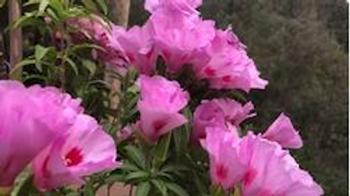 Clarkia amoeba is a native annual easily grown from seed. Photo: Bonnie Marks
- Proper design, emphasizing Zone 0, the first 5’ from your house and attached wooden decks, along with the other two zones;
- Consistent maintenance, using the least hazardous mulch, appropriate pruning, and proper watering; and
- Careful plant selection, growing natives, and avoiding plants with certain characteristics.
You’ll learn that proper design is essential. The most critical area is Zone 0, the first 5’ around your house and attached wooden decks. Also known as the “ember resistant zone,” Zone 0 is the area most vulnerable to embers falling and catching your house on fire. New regulations are currently being finalized by the California Department of Forestry and Fire Protection and should be available soon. In the meantime, all organic materials from this area, including plants, should be eliminated. Use non-combustible mulch: gravel, pavers, or concrete. Keep this area clear of other flammable items, including firewood, propane tanks, and trash bins. If you have a wooden fence attached to your house, swap out a couple of panels with a 5’ section of metal, or replace a wooden gate with a metal gate because wooden fences and gates can act as a wick to move fire to your structure.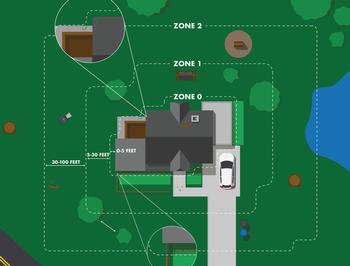 Pay attention to the three defensible space zones when designing your fire-smart landscape. Photo: Cal Fire
In Zone 1, 5’-30’ from your house, you can add plants, but space them out and intersperse them with hardscape such as pathways to break up a fire’s path. In Zone 2, 30’ and beyond, continue to focus on plant spacing, especially if you live on a slope where it’s important to have more spacing between plants.
You’ll learn that consistent maintenance is also crucial. Remove dead or dry plants, grass (including ornamental grasses), weeds, trees, and branches. Remove dead or dry leaves and pine needles from your yard, roof, and rain gutters. Remove and replace struggling plants. Make sure all plants are accessible and healthy. Remove combustible materials and debris on and under decks, overhangs, and fences. In Zone 1 and beyond, use the least hazardous mulch, such as composted wood chips, and avoid gorilla hair.
Focus on proper pruning and removing dead, dying, and diseased plant material. Prune to reduce bulk and create open structures to decrease the spread of fire. Cut back woody, twiggy, or overgrown shrubs that accumulate dry material (e.g., lavender). Cut back vines and low-growing groundcovers (e.g., ivy) to remove the build-up of dry stems and dead leaves. Thin and reduce tree canopies to remove twiggy growth, maintain separation between trees, and reduce overall fuel load. Remove dead or diseased branches. Gently thin and trim back tree canopies to remove twiggy growth and maintain separation between trees. Limb up trees 6-10 feet from the ground or up to one-third of their height. Avoid topping trees as this causes excessive branching, is unhealthy for the tree, and results in twiggy growth that can increase the fire hazard.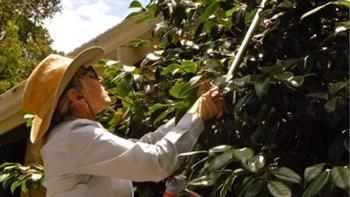 Proper pruning will reduce size and create space, helping prevent flames from reaching your home. Photo: Karen Gideon
Keep your plants well hydrated. Use an irrigation system to ensure efficient watering and check it regularly to ensure it is working, and there are no leaks.
Although design and maintenance are most important for a fire-smart landscape, you’ll also learn to choose native plants that use less water and attract pollinators. Avoid plants with certain characteristics, such as plants that: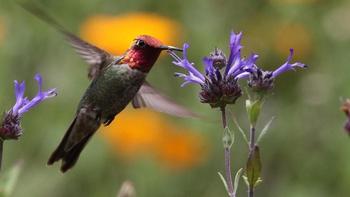 California natives in your garden, which need less water and attract pollinators. Photo: UC MMG
- Contain a lot of waxes, oils or resins which are likely more flammable and release more energy when they burn, like conifers.
- Have a denser structure, like juniper and cypress, that can capture embers and may be more likely to ignite, especially if the densely structured areas of the plant consist of dead and fine fuels.
- Shed a lot of bark or branches, which need more regular cleanup to reduce fuel accumulations on the ground.
UC MMG looks forward to seeing you at Ember Stomp; for more details, please visit https://firesafemarin.org/ember-stomp-2024/
For more information about fire-smart landscaping, please visit https://marinmg.ucanr.edu/BASICS/FIRESMARTLANDSCAPING/