

Plant a persimmon or pomegranate, perfect for Marin
-
Julie McMillan
-
You've decided to add a fruit tree to your garden. What kind should you select, when and where should you plant it, and how do you prune it? Consider a persimmon or a pomegranate; they are perfect for Marin!
Except for citrus, fruit trees require "chilling hours," a specific number of cumulative hours of chilling with temperatures between 32°F and 45°F to break their winter dormancy. Chill hours vary by type and can be as long as 7-9 weeks (e.g., pear and apple). "Low chill" fruit trees may be available. Two beautiful fruit trees need only minimal chill hours: persimmon (four days) and pomegranate (8 to 13 days), making them well-suited for Marin's warming climate.
Persimmons, called the "fruit of the Gods," originate from China. They have luscious, prolific fruit. 'Fuyu' (squat, rounded, and eaten raw) and 'Hachiya' (acorn-shaped, needs complete ripeness before eating raw, and good for cooking) are the most popular. Large, dark green, glossy leaves turn yellow in autumn. After leaf drop, fruit hangs on bare branches like orange ornaments. Purchase bare root from a quality nursery and plant during December – January after adequate and cumulative chilling hours have occurred. Persimmons are self-fertile, so planting one tree is fine.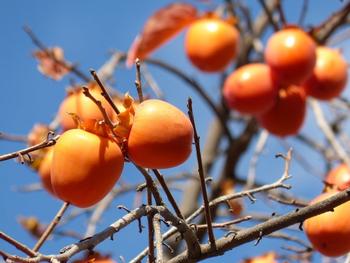 Hachiya persimmons shine like ornaments in the late fall. Photo: Pixabay.
Site your persimmon in full sun with adequate space to allow for air movement; they can reach 25' tall and wide. Persimmons will tolerate a variety of soil types, but if you have clay soil, amend it with compost before planting. Provide good drainage.
Irrigate in the spring when rainfall may be inadequate and in the summer to maintain moisture and prevent leaf and fruit drop. Once established, persimmons may withstand short periods of drought but need regular watering for a good crop.
Prune your persimmon tree in late winter or early spring when it is dormant and young to create a strong framework. Pinch off vigorous shoot growth in the first two years to force growth into the framework. Pruning mature trees should be light and focused on diseased, decayed, or damaged branches (consistent with fire-smart landscaping). Persimmons can also be pruned and trained to create a hedge, screen, or espalier. Unless your tree has excessive or dysfunctional growth, skip summer pruning because much of the fruit forms at the tips of the branches.
Pomegranates, native to the Middle East, are round, red fruits with white inner flesh packed with crunchy, juicy edible seeds called arils. Their Latin name means "apple with many seeds," but they look more like a petrified tomato. Pomegranates have shiny foliage and a long flowering season in the spring.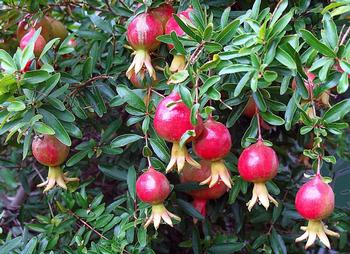 Pomegranates ripen on a bush in the fall. Photo: Pixabay
Plant in the spring, after the last frost. Pomegranates are self-fertile, but two or more plants together may improve fruit set. Pomegranates require a minimum of 6 hours of sunlight a day or full sun. They grow to 15' to 20' tall. Fruits crack with the first fall rains, so pick your fruit before the rain begins.
Pomegranates prefer loamy soil but tolerate sandy or clay soils. They require 36-48" of water annually. Keep the soil moist during the growing season and into fall to avoid split fruit. Pomegranates can withstand long periods of drought but won't produce much fruit. After years of drought, watering your pomegranate will help it produce fruit.
Pomegranates can be trained as a hedge or tree but grow naturally as a bush made of a tall, arching thicket of canes. If grown as a bush, keep the diameter of the base to 18-24" to make pruning easier and the fruit more accessible.
To prune a pomegranate in the winter, remove: dead, diseased, or damaged canes; crossing canes; canes that expand the base beyond the desired diameter; suckers that grow from the roots; outer canes that have sagged close to the ground; weaker inner canes, both to open the center to sunlight and to ensure that fruit will form on strong canes. Keep some inner canes to replace older canes because pomegranate fruit spurs produce for only about three to four years. Skip pruning your pomegranate in the summer unless there's excessive or dysfunctional growth.
For more information about chill hours for various fruit trees, visit: https://homeorchard.ucanr.edu/The_Big_Picture/Tree_Selection/
For more information about growing various fruit trees, visit https://marinmg.ucanr.edu/EDIBLES/FRUITTREES/