

Lessons learned from the leaves
-
Alice Cason
-
September marks the fall equinox and the start of autumn. It is time to see birds migrating, acorns ripening, and monarch butterflies flying toward their overwintering sites along the California coast. It is also the time to watch the trees and learn from the leaves.
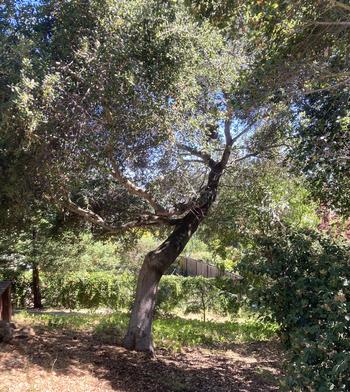 The leaves under my oak prevent weeds from sprouting and provide mulch and wildlife habitat for moths and butterflies. An owl box is in upper branches
A tree is a woody perennial plant with a long stem or trunk supporting branches and leaves. Trees are responsible for photosynthesis, converting sunlight, carbon dioxide (CO2), and water into carbohydrates (sugars and starches) and oxygen. Trees provide habitat and food for animals, birds, and insects. They help regulate climate and create the beauty of landscaped spaces. As fall approaches, leaves undergo a wonderful transformation, showing us vibrant colors.
Senescence is the process of aging in plants that leads to the gradual deterioration of cellular function and structure. In trees, it involves the breakdown of cellular components, resulting in autumn leaf color and the death of leaves, flowers, or other parts. This natural process is essential for the life cycle, allowing plants to conserve resources and prepare for new growth.
.
Leaves offer insights into nature's intricate balance and the essential role trees play in our ecosystem. Leaves indicate environmental health by their color, spots, blemishes, wilting, and curling. Water-stressed leaves may be smaller and drop prematurely. Leaves can also drop from excess water or poor root aeration. Shaded leaves tend to be larger and thinner to reduce water loss. Pollution damage can be stippling (small dots with no chlorophyll) from ozone and other pollutants.Evergreen trees (like pines) retain their leaves year-round but still may shed older leaves in a periodic pattern. At the other end of the spectrum are deciduous trees (like maples) that turn a myriad of bright colors and seem to drop their leaves all at once in the fall and winter months.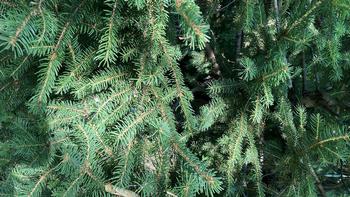 Evergreen trees have needle-like leaves with a waxy coating adapted to reduce water loss. Their shape prevents them from freezing in the winter.
Certain tree species, including some of our oaks, retain their dead leaves beyond the usual period of senescence. This is called marcescence. The trees hold onto the leaves into the winter months, creating a striking contrast against bare branches, then shed them in the spring.
Some ecologists suggest that marcescence has an adaptive significance and that retaining leaves until spring slows their decomposition, and dropping them in the springtime creates a new mulch when the parent tree most needs it. The leaves function as protection for the new buds until spring and a deterrent to deer eating those new buds. Some suggest that the leaves serve as protection from frost.
In my Oak Woodland in San Rafael, I enjoy seeing the oak leaves slowly accumulate and decompose under 50+-year-old coastal live oak trees (Quercus agrifolia). We don’t blow, rake, or shred the leaves, which would destroy insects that feed the birds and the pollinators that nest in the ground. The leaves prevent weeds, provide mulch, and nourish the soil. We leave the acorns to be eaten by birds and squirrels.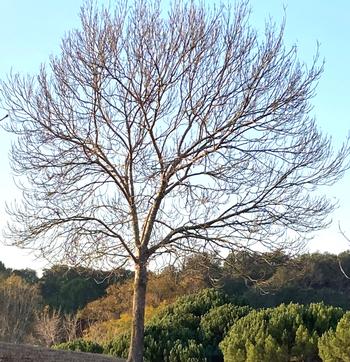 Deciduous trees shed their leaves annually, usually in the fall, allowing them to conserve water and energy in winter months. Photos: Alice Cason
To practice fire-smart landscaping, keep the root crowns clear, remove dead branches, and limb the trees up to the right height from the ground. The trees are a distance from the house and not near Zone 0 (5 feet from the house).
According to author and professor of entomology Douglas Tallamay, Ph. D., the SF Bay Area oak trees have 270 species of butterflies and moths that will lay eggs on them. These are native species that rely on oaks for their survival. Oaks are considered keystone plants due to their pivotal role in the food chain.
So, before you rake up the leaves and take them away, consider their importance to the trees. If you have oak trees, enjoy the slowly falling leaves protecting the roots of our environmental allies.