

Hold your nose and pull this weed
-
Barbara Robertson
-
Whenever someone describes a plant as “aromatic,” the question to ask is whether the aroma is pleasant or unpleasant. In the case of Stinkwort (Dittrichia graveolens), the answer is in the name. “Wort” is Old English for “plant.” Therefore, stink plant. And it’s stinky for another reason: It’s an invasive weed, sometimes harmful, one you’d be wise to remove. But wear gloves when you do.
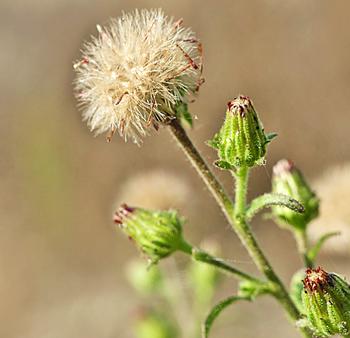 Stinkwort flowers and produces seeds from September through December. The seeds germinate over winter but can germinate at any time.
The odor, variously described as medicinal, chemical, tar-like, and similar to creosote or camphor, comes from a sticky resin that can cause allergic reactions and dermatitis in humans. The resinous foliage is not attractive to animals, but if animals eat it, it can taint their milk and meat and fatally damage their digestive systems. The culprit for the digestive damage is barbs on the seeds, barbs that also help it spread. The unpalatability means there are no natural checks on the plant’s growth. It’s a clever stinker.
First seen in California near Milpitas in 1984, the Mediterranean native has since expanded exponentially to all the Bay Area counties, including Marin, and to Sonoma, Napa, and beyond. Unattractive and nondescriptive, it often grows on roadsides and other disturbed land, including that ravaged by wildfire, and it’s easily ignored.Like many weeds, the annual plant tolerates a variety of soil conditions, temperatures, and rainfall. Unlike many, though, it matures late in the year. After beginning to bolt in mid-May, it produces most growth between June and September, then flowers and produces seeds from September to December. The flower heads are tiny, with yellow ray flowers on the edge becoming reddish in the center. They puff open with white hairs when ready to seed. The seeds typically germinate in the winter but can germinate at any time. The leaves have sticky hairs covered with the resin and, likely, dust and particles stuck on them. The plant grows into a pyramid or sphere shape, 2.5 feet tall or so, and can resemble a Russian thistle (tumbleweed) from a distance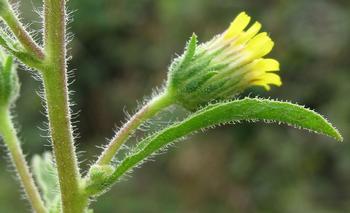 Stinkwort's sticky hairs are covered with stinky resin that, if touched, can cause allergic reactions and even dermatitis in humans.The two best biological and cultural ways to prevent a stinkwort invasion are limiting soil disturbance and manipulation and encouraging a dense ground cover. To remove stinkwort, you can take advantage of the plants’ typical slow-growing and initially shallow-rooted nature by hoeing or pulling them out. But always remember that they can cause dermatitis, so cover yourself well. Then, bag flowering plants and remove them. Mowing can help control stinkwort if done in June or later in the season – before flowering. Too early simply removes the competition, leaving the young stinkwort plants unaffected by the mower blades. As for chemical controls, the sticky oil on the leaves makes it difficult to kill them with postemergence herbicides. Pre- and early postemergence herbicides applied in winter or spring showed more potential; however, some unfortunately prevented favorable vegetation from emerging instead. As with all chemical controls, be cautious.
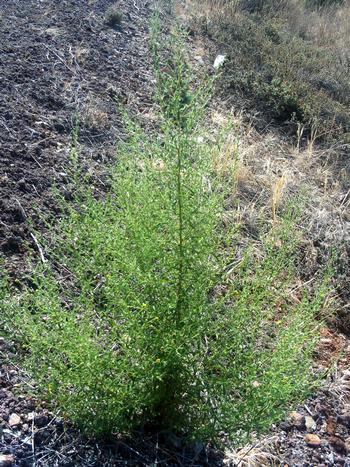 Stinkwort, an invasive weed, colonizes open disturbed places like roadsides. It tolerates a variety of soil conditions, temperatures, and rainfall.
I am always curious to know if a noxious plant has any redeeming qualities, and, indeed, there are some possibilities for stinkwort. Researchers in Turkey found that aqueous extracts of stinkwort in various concentrations inhibited the seed germination of five plants considered noxious weeds and, on the other hand, positively contributed to the growth of tomato seedlings. So, it’s a potential area for further research.
As for now, if you see stinkwort in your garden, don’t hesitate. Put on your gloves, plug your nose, and dig it up. For more info on all weeds, see: https://marinmg.ucanr.edu/PROBLEMS/WEEDS_-_INVASIVE_PLANTS/.