

Succulents that attract hummingbirds, bees, and other pollinators
-
Pamela Noensie
-
There’s so much to love about succulents—the fascinating patterns of their foliage, their incredible ability to hold water, and their flowers.
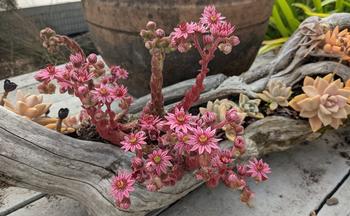 Sempervivum arachnoideum (hens and chicks) in bloom. Being monocarpic, they flower once, and after they bloom, they die. Photo: Lillian Trac
Flowers?
Yes, all succulents produce beautiful flowers—some each year, and some aloe succulents can even bloom several times a year. And these flowers can attract a wide range of beneficials--hummingbirds, bees, and many more—to our gardens. Most of the beneficials will be drawn in by the colorful flowers to feed on their nectar. But others, like the praying mantis, come to eat insects off the flowers.
If you want to add some succulents to your garden, come to the Marin Master Gardeners’ annual succulent sale on May 18, 2024 (sale details at the bottom of the page).
The following are just a few of the more than 90-plus varieties of succulents that will be available at the sale.
- Aeoniums. These belong to a group that will flower in Marin’s cool, wet winters, perhaps because many originate off the coast of Africa with its similar Mediterranean climate. Aeonium simsii is one species with sunny yellow flowers that attract bees and butterflies in the spring. This plant makes a lovely ground cover with rosettes that spread by pups.
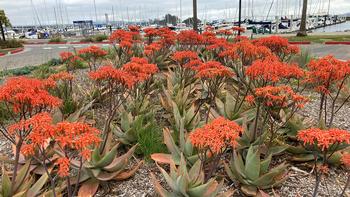 Aloes growing in San Rafael in February. Photo: Alice Cason
 - Aloe is a genus with hundreds of species, one of which is Blue Elf Aloe. Like most aloes, this species has thick, fleshy leaves with tubular flowers loved by hummingbirds. The spikes of orange flowers appear in winter and bloom through April in Marin. They look great in containers or planted in mass.
- Rock purslane (Calandrinia grandiflora) is native to Chile. This succulent has stunning magenta flowers on long stems, which are often visited by carpenter bees. This plant works well in rock gardens.
- Hens and chicks is a name commonly associated with sempervivums, but also with echeverias. Although both have interesting flowers, the sempervivums are particularly gorgeous. This beauty comes with a price, as the plant will die after flowering, whereas the echeverias flower year after year. Both are spread by pups.
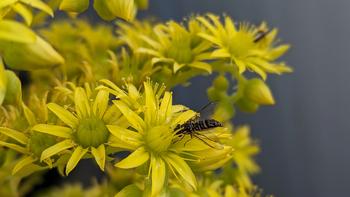 A syrphid fly on Aeonium flower. Syrphid flies are under-appreciated beneficials that feed on pollen & nectar and eat mealybugs & aphids. Lillian Trac
 - Dudleya is a genus easy to grow in coastal places. Hummingbirds love the bell-shaped flowers. One native species is Catalina Island Live Forever (Dudleya hassei), which has red or yellow flowers. The foliage forms white “fingers” that turn pinkish in the dry season. It grows well in pots or rock walls, in full sun or part shade. (Dudleya farinosa is another similar native).
- Sedums. Members of the Sedum family display clusters of tiny star-shaped flowers that attract bees, birds, and butterflies. They bloom in winter, spring, and fall. Some plants are short groundcovers, while others, like the Sedum Autumn Joy, are taller plants.
The Marin Master Gardener succulent sale will have many varieties available, each chosen for their suitability for Marin gardens. With the right mix you can enjoy these fascinating plants while feeding beneficials in your garden year-round.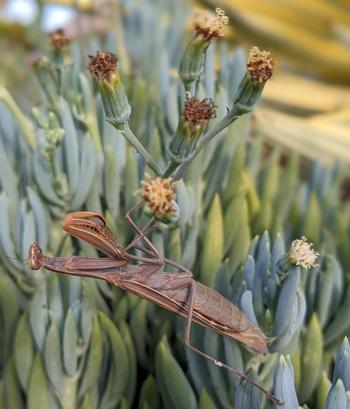 A praying mantis hanging upside down on blue chalk sticks (Curio talinoides var. mandraliscae) that has yellow flowers. Photo: Lillian Trac
The sale will be held at the San Rafael Falkirk Cultural Center Demonstrations Gardens, 1408 Mission Avenue, on Saturday, May 18, from 9:00 am to 12 noon. Marin Master Gardener Succulent Sale
For information on planting succulents, see the UC Marin Master Gardener YouTube video: https://www.youtube.com/watch?v=DrABCo3C2Rs