
Native groundcovers planted this fall will keep your soil healthy for years to come
-
Pamela Noensie
-
Fall is the best time to plant natives. The winter rains will help their roots dig in deep. Native plants most often reach their full size in a couple of years; during that time, they may need regular watering. Otherwise, they are mostly maintenance-free.
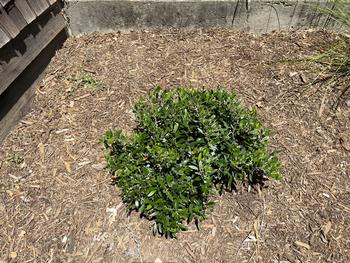 Newly planted Bearberry Manzanita (Arctostaphylos uva-ursi ‘Point Reyes’) with plenty of room to spread out at Fairfax Library. Pamela Noensie
Most important in selecting a groundcover is where it will grow. In shade or sun? In a dry or wet area? In a pot or on a slope? In addition, for replacing a grass lawn with native groundcovers, consider how you use the lawn and select the plants for your preference for size and walkability.
There are three native groundcovers known for their ever-green beauty and tough woody stems. The first is a Bay area native commonly called Bearberry Manzanita (Arctostaphylos uva-ursi ‘Point Reyes’). Bearberry grows one and a half feet high and slowly spreads to eight feet wide. It thrives in partial sun to light shade, developing tiny bell-shaped flowers in winter, followed by red berries much loved by wildlife. Tough leathery leaves make it deer-resistant.
The other two woody plants are Anchor Bay Creeping Ceanothus (Ceanothus gloriosus ‘Anchor Bay’) and Pigeon Point Coyote Bush (Baccharis pilularis ‘Pigeon Point’). These grow well in the sun near the coast but need more shade inland. Anchor Bay Ceanothus is covered in stunning blue-violet flowers in the spring. Deer will nibble, but not destroy, the young leaves.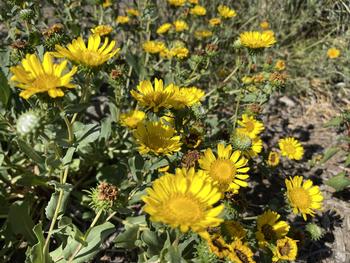 San Francisco gum plant (Grindelia hirsutula var. maritima) provides food for pollinators in summertime when other natives are dormant. Pamela Noensie
Non-woody, herbaceous groundcovers include a wide variety of plants. I mention a few of my favorites below. Don’t be afraid to mix them—most natives look great together.
Beach strawberry (Fragaria chiloensis) forms a green mat four inches high. It does well in sun or partial shade and spreads by runners with white flowers followed by edible berries. Deer resistant.
Wild ginger (Asarum caudatum) is not related to culinary ginger but is a member of the pipevine family. It has heart-shaped leaves and favors a shady, moist area.
Yerba Buena (Clinopodium (Satureja) douglasii) is a creeping herb (good for tea) that grows in shade. Although it can be crowded easily by larger plants in the garden, it does well in pots.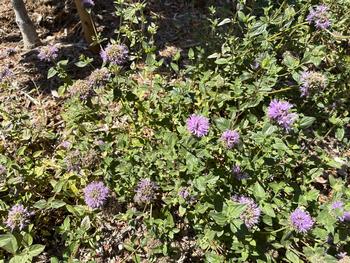 Aromatic coyote mint (Monardella villosa) is a host to several moths and butterflies. Pamela Noensie
A few native plants burst into color in the summer when the majority are fading into their dormant period. For instance, San Francisco gum weed (Grindelia hirsutula var. maritima) produces bright yellow flowers in summer and fall. Coyote mint’s (Monardella villosa) aromatic purple flowers attract bees and butterflies. And California fuchsia (Epilobium canum) has firecracker red tubular flowers loved by hummingbirds. All of these are sun-loving, drought-tolerant, and deer-resistant.
Native clovers and grasses also make good groundcovers. Clover has the added benefit of being walkable while also enriching the soil with nitrogen. Seeds can be found at some local native plant stores or online.
Since all plants can burn, the latest fire safety advice is not to plant any plant within five feet of your home. Further away, allow plenty of growing space, filling in with non-combustibles such as gravel or rocks. In the fire season, keep plants well hydrated and prune out dead leaves.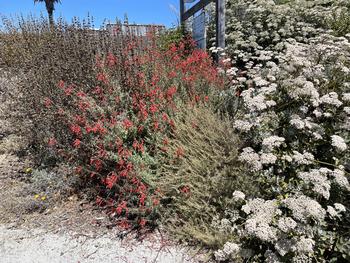 The red tubular-shaped flowers of the California fuchsia (Epilobium canum) provide nectar in the fall for local Anna's hummingbirds. Pamela Noensie
No matter what size your garden is, native groundcovers are incredibly versatile, easy to maintain, and will keep your soil healthy for many years to come.
For more on groundcovers, see our UC Marin Master Gardener website under plants.